Must read!
Book
Read Entirely
Read one time
Language
Italiano
Publishing house
Mondadori
Position in the list
22
The Review
"Great book"
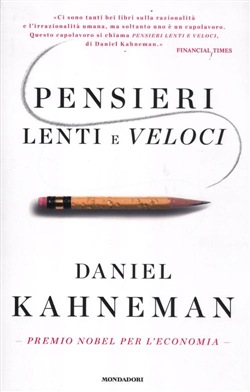
A must-read. A state-of-the-art overview on our knowledge of how our brain works when taking decisions, making estimates etc. Main take away: rational behavior (still key assumption in economics, and not only) can not explain everything about the way we act. Actually, it does not explain a large part of what we do. This is the case because the brain operates only rarely in a "rational", self-conscious way. "By default", it works through heuristics and shortcuts that are great in allowing us to cope with reality but suffer also from biases and limitations. The book goes through these biases and limitations. Did you know that we are not good at thinking statistically? Or that we are averse to risk when deciding about likely gains, but (often tragically) risk-seeking when deciding about likely losses? Or that - when assessing ex post an event - we assess its peaks and its end, almost not considering all the rest of it? Or that we consistently overestimate our ability to predict what will happen (without detecting the overestimation... neither after our expectations did not come true)? Etc. etc. Extremely well written by Daniel Kanheman, psychologist, Nobel prize in Economics. Super-recommended.
A must-read. A state-of-the-art overview on our knowledge of how our brain works when taking decisions, making estimates etc. Main take away: rational behavior (still key assumption in economics, and not only) can not explain everything about the way we act. Actually, it does not explain a large part of what we do. This is the case because the brain operates only rarely in a "rational", self-conscious way. "By default", it works through heuristics and shortcuts that are great in allowing us to cope with reality but suffer also from biases and limitations. The book goes through these biases and limitations. Did you know that we are not good at thinking statistically? Or that we are averse to risk when deciding about likely gains, but (often tragically) risk-seeking when deciding about likely losses? Or that - when assessing ex post an event - we assess its peaks and its end, almost not considering all the rest of it? Or that we consistently overestimate our ability to predict what will happen (without detecting the overestimation... neither after our expectations did not come true)? Etc. etc. Extremely well written by Daniel Kanheman, psychologist, Nobel prize in Economics. Super-recommended.


