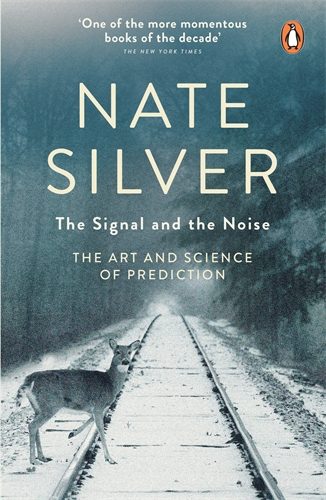
Must read!
Book
Non-fiction
Read Entirely
Read one time
Language
English
Publishing house
Penguin Books
Series
Economics
Edition number
9
Publication year
2013
Number of pages
534
Position in the list
27
The Review
"Forecasting, predicting and making sense of lots of data: a must-read"
There are some books able to intercept the defining topics of a specific time in history and to introduce even the layman to them. This book is one of such books. Written in a captivating style, rich of anecdotes and examples from many different fields - most of them directly touched by the author in his own, phenomenal experience - the book is at the same time strongly instructive and entertaining. It does an amazingly good job explaining to the reader the way forecasts and predictions are made, their key characteristics, why they sometimes succeed and often don't, why having a lot of data at hand is good but might be not enough, actually ending up in being an element of confusion and deception, instead of helping to improve estimates. The book contributes to closing the wide gap between the common perception of easiness in formulating precise and accurate forecasts and predictions, on one hand, and its actual difficulty, on the other. Silver indeed describes effectively the role of statistics and probability in estimates of what will happen, something often not fully understood by the general public.
Also, the book overtly supports Bayesian methods and their pragmatic approach based on degrees of belief, illustrating the limits of "objective" probabilities, often made useless or deceiving by somewhat "heroic" underlying assumptions.
Finally, the first pages of "The signal and the noise" make a very exact point: "information revolutions", on the short to mid term, might have terrible impacts: press had a lot to do with the religion wars that soon afterwards tormented Europe. "We face danger whenever information growth outpaces our understanding of how to process it": it might happen today as well, when we are living a sort of new information revolution, with huge amounts of data readily available to everybody, for the first time in history.
Recommended to any reader from early XXI century, to better understand the world she lives in.
There are some books able to intercept the defining topics of a specific time in history and to introduce even the layman to them. This book is one of such books. Written in a captivating style, rich of anecdotes and examples from many different fields - most of them directly touched by the author in his own, phenomenal experience - the book is at the same time strongly instructive and entertaining. It does an amazingly good job explaining to the reader the way forecasts and predictions are made, their key characteristics, why they sometimes succeed and often don't, why having a lot of data at hand is good but might be not enough, actually ending up in being an element of confusion and deception, instead of helping to improve estimates. The book contributes to closing the wide gap between the common perception of easiness in formulating precise and accurate forecasts and predictions, on one hand, and its actual difficulty, on the other. Silver indeed describes effectively the role of statistics and probability in estimates of what will happen, something often not fully understood by the general public.
Also, the book overtly supports Bayesian methods and their pragmatic approach based on degrees of belief, illustrating the limits of "objective" probabilities, often made useless or deceiving by somewhat "heroic" underlying assumptions.
Finally, the first pages of "The signal and the noise" make a very exact point: "information revolutions", on the short to mid term, might have terrible impacts: press had a lot to do with the religion wars that soon afterwards tormented Europe. "We face danger whenever information growth outpaces our understanding of how to process it": it might happen today as well, when we are living a sort of new information revolution, with huge amounts of data readily available to everybody, for the first time in history.
Recommended to any reader from early XXI century, to better understand the world she lives in.


